The Grain Beneath the Gloss: Editing Product Descriptions for UK Makers Without Erasing the Hand Behind Them
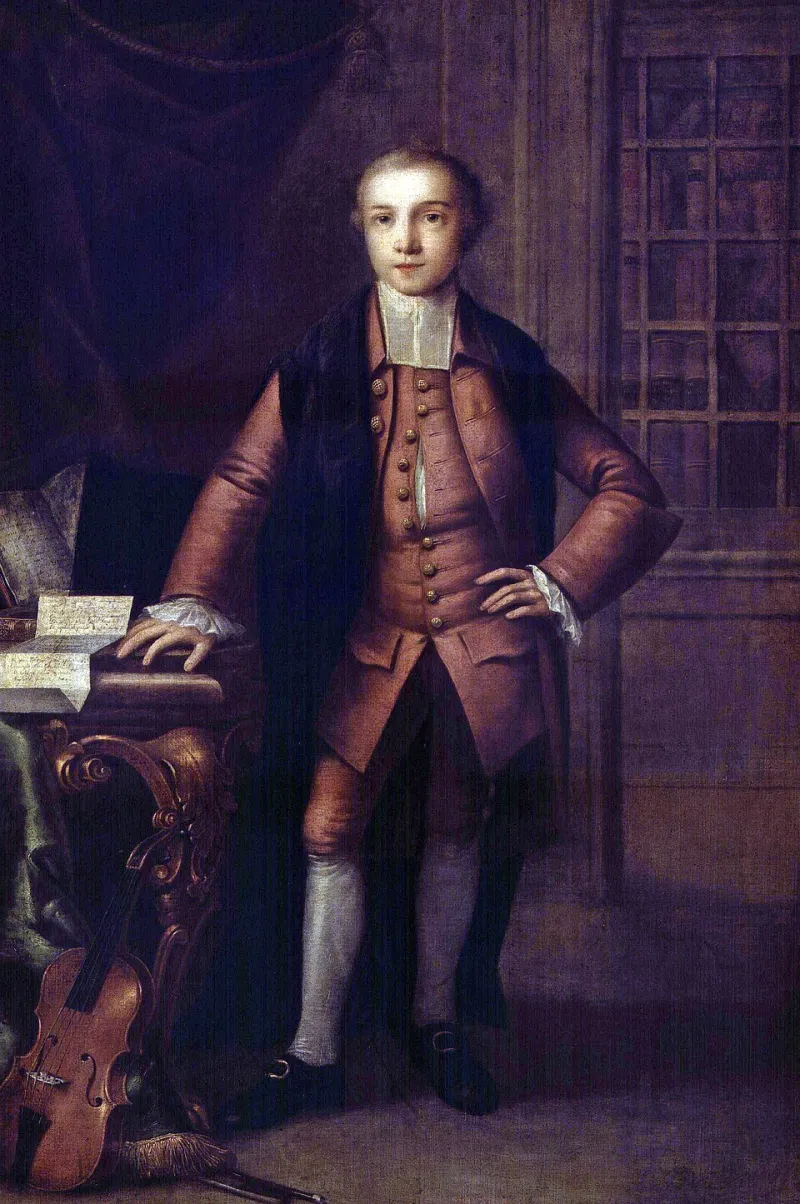
Photo: Thomas Frye, Public domain, via Wikimedia Commons
Product copy written by an independent UK maker is often the most alive writing on the internet. It has a pulse: a slightly overlong aside about a kiln, a confession about packaging, a sentence that begins 'I made this because...' and ends somewhere unexpected. Then an editor is hired, and the copy comes back as a bulleted list of specifications with the pulse sanded out. The maker's label has been replaced by a care label.
The mistake is understandable. Product descriptions have to do several jobs at once. They must answer the buyer's practical questions, satisfy the search terms that lead to the page, and remain accessible to readers using screen readers or translation tools. But none of those jobs requires the copy to sound as if it were written by a committee. The editorial task is not to remove the grain; it is to make the grain legible.
Why product copy is a peculiar editorial problem
Most editorial work begins with a text that wants to be read. Product copy begins with a text that wants to be found, understood and trusted in roughly that order — and often by three different readers at once. The buyer wants to know what the thing is, how big it is, what it is made of and whether it will arrive before a birthday. The search engine wants nouns and phrases that match a query. The screen reader wants structure: headings, lists, meaningful link text, alt text that describes rather than repeats.
The maker's voice is a fourth reader, and the one most easily forgotten. It is also, commercially, the differentiator. A hand-thrown mug from a studio in Stoke is not competing with a factory mug on specification. It is competing on the fact that a person made it, and the copy is often the only part of the transaction that carries that person. An edit that removes the voice has removed the product's main advantage.
The three tests for a quirky phrase
When a phrase looks odd, the question is not whether it is odd. The question is what it is doing. Three tests are usually enough.
Does it carry a fact? 'Made with love' carries nothing on its own. 'Made with love and a three-week lead time' carries two things: a brand attitude and a delivery expectation. The second earns its place; the first needs a companion.
Would the maker say it to a customer at a market stall? This is a useful test because it separates voice from performance. A ceramicist might well say 'I fire these in a kiln in my garden and I have ruined more than one pair of shoes doing it.' That is voice. A copywriter's insert about 'curated artisan living' is not voice; it is costume.
Does it cost the reader anything? Some quirks are charming; some are barriers. A joke that depends on a cultural reference, an idiom that assumes a body or a background, a measurement that only works in one system — these are costs. They can be paid, but the editor should know they are being paid.
Before and after: a ceramicist in Stoke
Consider a paragraph of copy from a small pottery:
My mugs are made in my garden studio in Stoke with a lot of swearing and a decent amount of clay. They're proper sturdy and hold a decent brew. Please don't put them in the dishwasher because I'll cry.
The voice is clear and worth keeping. The problems are practical. 'Proper sturdy' is a claim without a measure. 'A decent brew' is a size without a number. 'Please don't put them in the dishwasher because I'll cry' is memorable but not informative: the buyer does not know whether the mug will crack, craze or simply lose its glaze.
An edit that preserves the voice:
My mugs are made in my garden studio in Stoke, with a lot of swearing and a decent amount of clay. Each one is hand-thrown in thick-walled stoneware and holds about 350ml — a proper brew. Hand-wash only, please: the glaze is food-safe, but the thermal shock of a dishwasher can craze it, and I will cry.
The swearing stays. The garden studio stays. The joke about crying stays, because it is doing the work of a care instruction. What changes is that the buyer now knows the material, the capacity and the reason for the instruction. The copy has not been sanded; it has been given edges.
Before and after: a candle maker in the Cotswolds
Now consider a candle description:
Our candles are made from 100% natural soy wax and smell like a walk through the woods after rain. Burn time is about 40 hours.
The simile is good, but it is doing too much work. 'A walk through the woods after rain' could mean moss, pine, wet earth or petrichor. The buyer cannot tell whether they are getting a green scent or a woody one. The search engine cannot tell either.
A voice-preserving edit might read:
Our candles are made from 100% natural soy wax, with a cotton wick and no synthetic fragrance. The scent is woodland after rain: wet moss, pine needle and a little cold earth. Burn time is approximately 40 hours when burned in a draught-free room.
The simile is kept, but it is unpacked into notes the buyer can recognise. 'Natural soy wax' becomes a searchable phrase. 'Cotton wick' and 'no synthetic fragrance' answer questions that buyers actually ask. The edit has not replaced the image; it has given the image a specification.
Search terms are not a separate language
There is a persistent belief that copy must choose between readability and search. In practice, the most useful search terms are the ones a buyer would actually type, and those are usually plain nouns: 'hand-thrown mug', 'soy wax candle', 'woodland scented candle', 'dishwasher safe'. The editorial task is to place them where they do the most good — in the first sentence, in a subheading, in a specification list — without turning the paragraph into a keyword inventory.
A useful rule of thumb: the first sentence should contain the most specific noun the buyer would use. Not 'Our story', not 'Welcome to the studio', but 'This hand-thrown stoneware mug...'. The voice can follow immediately. Search engines and hurried readers both reward the same thing: early clarity.
Accessibility is not the opposite of personality
Accessible copy is often described as if it were a constraint on style. It is better understood as a constraint on assumption. A description that says 'simply pop it in the dishwasher' assumes a dishwasher. A joke that depends on 'tone-deaf' assumes a hearing norm. An alt-text that says 'image' assumes nothing useful at all.
The fix is rarely to remove the personality. It is to add the missing information. 'Hand-wash only' is not less charming than 'please don't put it in the dishwasher because I'll cry'; it is simply more useful. The two can sit in the same sentence.
A short checklist for the maker's label
Before cutting a quirky phrase, or keeping one, run it through these questions.
- Does it carry a fact, a feeling the brand has earned, or an answer to a question the buyer is likely to ask?
- Would the maker say it out loud to a customer at a market stall?
- Does it assume a body, a budget, a background or a piece of cultural knowledge that not every reader has?
- Can a screen reader navigate the page? Are there headings, lists and meaningful alt text?
- Does the first sentence contain the noun the buyer would type into a search engine?
- Are measurements given in metric, with imperial in brackets where a UK audience expects it?
- Does 'handmade' specify the hand: hand-thrown, hand-poured, hand-sewn, hand-finished?
The label is the copy
A maker's label is usually a small piece of paper with a name on it. Online, the label is the copy itself. It is where the buyer meets the maker, and where the maker's voice either survives the transaction or disappears into a specification sheet. Editing that copy is not a matter of polishing away the rough edges. It is a matter of deciding which rough edges are load-bearing, and which are simply in the way. The grain should remain visible. It is the proof that someone was there.