Reading Aloud Is Not Enough: A Manuscript Pass for Audiobook Production
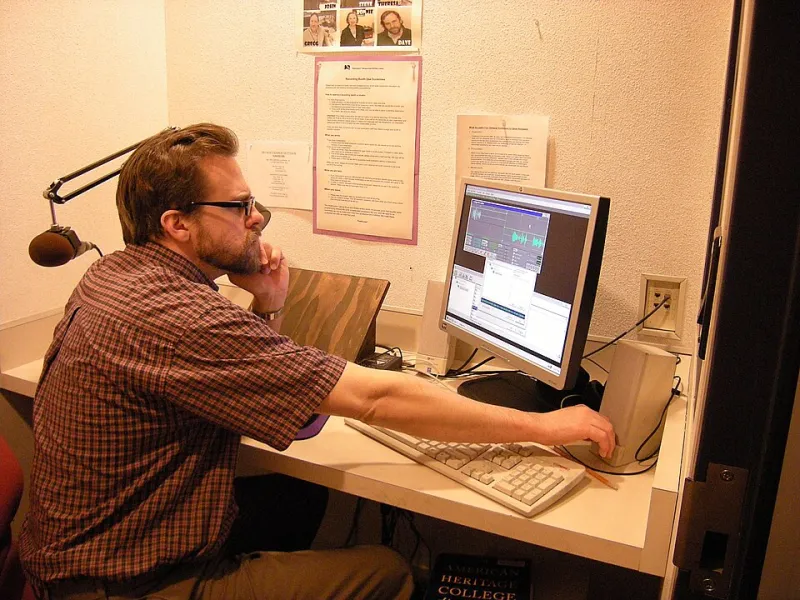
Photo: Joe Mabel, CC BY-SA 3.0, via Wikimedia Commons
An audiobook is not simply a book that has been spoken. It is a performance text, and a manuscript that reads cleanly on the page can still stumble in the studio. The editor's task is not to flatten the prose into something easy to narrate, but to make it performance-ready without sanding down the qualities that make it worth hearing. That distinction matters. Audio preparation is a second edition for the ear, not a mechanical read-aloud.
A Different Kind of Proof
Reading a manuscript aloud will catch some problems: a missing word, an awkward clause, a sentence that runs out of breath. It will not catch everything. A dedicated audio pass looks at the text through the narrator's eyes, asking where a skilled reader might plausibly go wrong and where a listener might lose the thread. This is editorial work, not technical checking. It belongs alongside the copyedit and the proof, not after them as an afterthought.
Homographs and the Limits of Context
English is full of words that look alike and sound different. Context usually settles them, but not always, and not always quickly enough for a narrator reading at pace. Consider the difference between lead as a metal and lead as a verb, wind as movement of air and wind as a verb, row as a line and row as an argument, tear as a rip and tear as a drop from the eye. Then there are minute, close, invalid, bass, moped, polish and number. Most will be clear from the sentence; some will not. A pronunciation log is the practical answer: a separate list of words that need a decision, with context and a suggested pronunciation. It takes minutes to compile and saves hours in the booth.
UK place names deserve particular attention. Loughborough, Leicester, Edinburgh, Greenwich, Norwich, Frome, Bicester, Marylebone and Southwark are routine traps for narrators who have not grown up with them. So are surnames, invented names in fiction, and acronyms that may be spoken as words or as letters. The editor need not pronounce everything correctly, but the editor should notice what needs deciding.
Dialogue Attribution: Invisible but Audible
On the page, readers track speakers visually. In the ear, dialogue attribution becomes a signpost. This does not mean every line needs a speech tag, and it certainly does not mean replacing said with more colourful verbs. Said is largely invisible, which is why it works. The real issue is clarity in multi-speaker scenes. A paragraph break may signal a change of speaker to the eye, but the listener has no paragraph break. Names need to recur at intervals. Pronouns need unambiguous referents. A line of dialogue followed by an action beat can be clear on the page and muddy in the ear if the beat could belong to either speaker.
Punctuation also behaves differently when spoken. Dashes and ellipses become pauses; semicolons may vanish entirely; exclamation marks can sound louder than intended. The editor should flag passages where the punctuation is doing work that the narrator cannot reproduce, and consider whether a small recasting would help. The aim is not to simplify the prose but to make the intended performance audible.
When the Page Points Elsewhere
Visual references are among the most common audio problems. The table below, see figure 2, as shown opposite, the following list, the italicised phrase: these are natural in print and disruptive in audio. Some can be replaced with spoken equivalents; some need a narrator note; some should be cut from the audio edition with the author's agreement. Footnotes and endnotes require an explicit decision. Will they be read, skipped, or folded into the main text? The same applies to epigraphs, dedications, appendices and chapter headings.
Abbreviations and symbols need similar attention. E.g. and i.e. may be read as Latin or as English; PLC, MP, NHS and SQL may be spelled out or spoken as words. Dates can be ambiguous: 9/11 is not the same on both sides of the Atlantic. Currency, measurements and ranges should be read in a way that suits the UK listener. None of this is glamorous work, but it is the difference between a smooth narration and a session punctuated by queries.
The Narrator Note: Clarify, Don't Conduct
The narrator note is a useful tool and a tempting distraction. Its purpose is to clarify, not to over-direct. A good note might give a pronunciation, identify a tone, or explain a recurring term. A bad note tries to conduct every sentence. Narrators are interpreters; they need information, not a script for their performance. Keep notes concise, consistent and separate from the manuscript. A simple format works well: word or phrase, suggested pronunciation, and a brief context. For fiction, note character names and any accent that matters, but avoid caricature. For non-fiction, note acronyms, technical terms and whether tables or figures are being referenced.
Preserving the Author's Rhythm
Audio preparation can tempt an editor towards over-simplification. Short sentences can become choppy; long sentences can become breathless. Deliberate fragments, rhetorical questions, alliteration and assonance may look untidy to a cursor but sound distinctive in the ear. The editor's job is to flag genuine hazards, not to rewrite cadence. Where a sentence is difficult to read aloud, ask whether the difficulty is accidental or intentional. If it is intentional, keep it and note it. If it is accidental, fix it lightly.
A Short Checklist
A practical audio pass might include a pronunciation log, a dialogue clarity check, a visual reference sweep, decisions on front and back matter, a narrator note, and selected read-aloud spot checks. At Vaughn Chambers, we treat audio preparation as an editorial task in its own right: a chance to protect the author's voice while helping the narrator deliver it. The goal is not a flattened text. It is a text that can be performed with confidence.